Why I Treat AI as a Teammate Not a Strategy
AI was derailing my focus until I stopped chasing trends and started treating it like a teammate on my solo team.
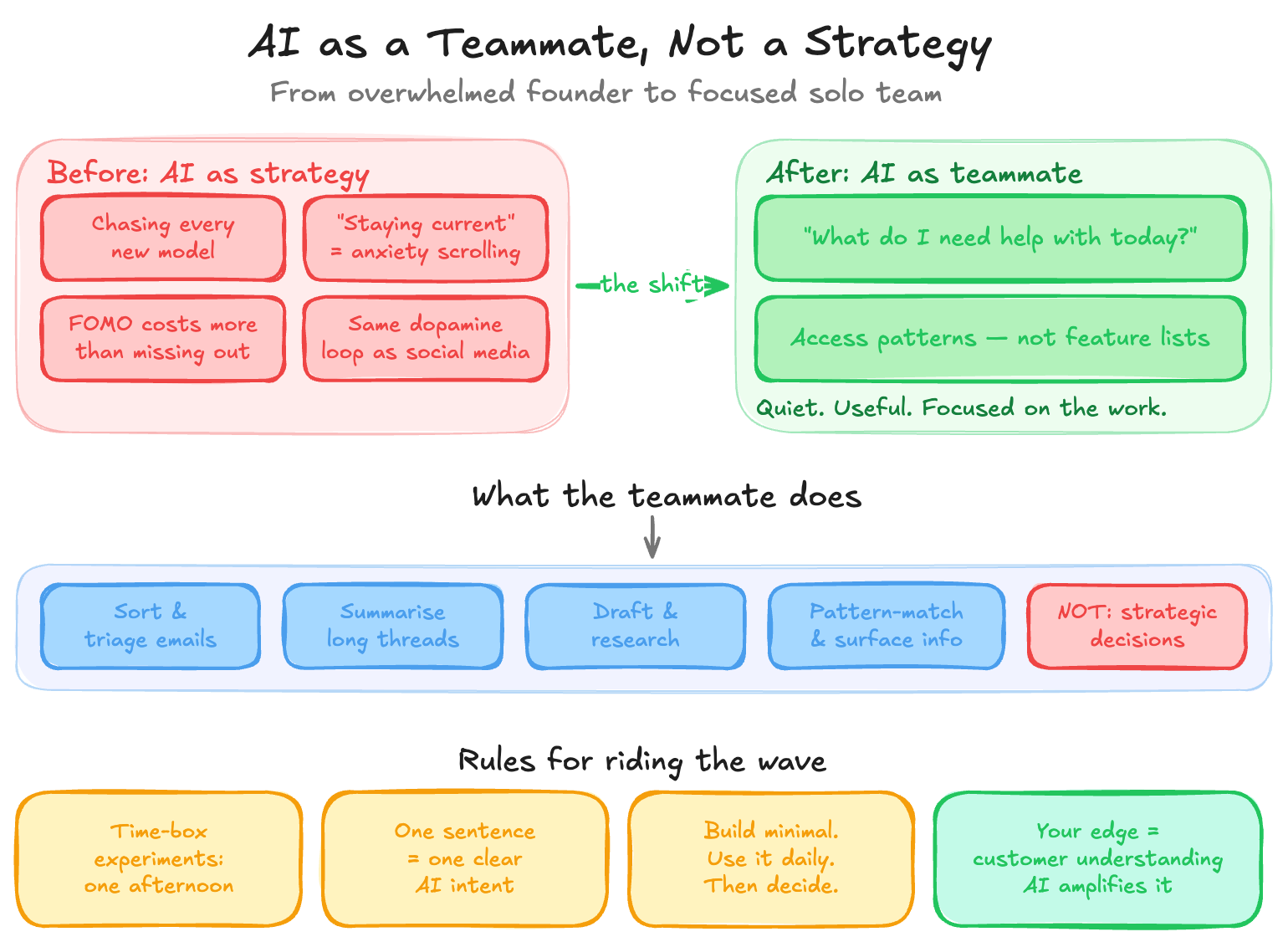
For a while I was treating AI like a strategy. Evaluating every new model, trying every agent framework, reading every thread about what just shipped. I thought staying on top of it all was part of running a good business. Turns out it was pulling me away from running my business.
The shift happened when I stopped asking “what can AI do?” and started asking “what do I actually need help with today?” That’s when AI went from being this big overwhelming thing I had to keep up with to something more like a teammate. Quiet, useful, focused on the work. I borrowed a concept from my DynamoDB days: access patterns. Define what information you need and when you need it, then figure out if AI can deliver it. Simple as that.
I don’t have an AI strategy anymore. I have a solo business with AI as a teammate. Here’s what that looks like in practice.
The FOMO Trap Is the Real Productivity Killer
- The fear of missing out costs more than actually missing out. You can always catch up on a tool later. You can’t get back the week you spent evaluating five different agent frameworks instead of shipping.
- Think about how much of your “AI research” is actually productive versus just anxiety-driven scrolling. Be honest with yourself about that split.
- Today’s flavor will change tomorrow. The model that’s dominating the conversation this week will be old news in a month. That’s not a reason to ignore it, but it is a reason not to panic about it.
- Something to consider: the people hyping the latest tool often have very different incentives than you. They’re building audiences. You’re building a business.
- Phone mode is real. The constant pull to check what’s new, who shipped what, what benchmark got crushed. It’s the same dopamine loop as social media, just dressed up as productivity.
Start From What You Need, Not What’s Available
- Define your access patterns before you touch any tool. What information do you want? When do you want it? How should it be delivered? Start there, not with the tool’s feature list.
- I wanted a daily summary of important customer emails. That’s an access pattern. I didn’t need a fancy agent framework for that. I needed something simple that actually worked.
- Build the minimal version first and use it daily. Don’t go deep on memory systems, plugin architectures, or complex chains. Get the smallest thing working and see if it adds value to your day-to-day.
- Think about the last AI tool you tried. Did you start from a problem you had, or from a demo you saw? That distinction matters more than you’d think.
- If you can’t describe what you want the AI to do in one sentence, you probably don’t need it yet. Clarity of intent is everything.
AI as a Teammate, Not a Strategy
- AI can help you run your business. That’s different from making AI your business. Use it to pull information together, research, draft, and triage. Don’t let it replace your critical thinking.
- I’ve found the biggest wins aren’t AI features in my product. They’re AI helping me personally. Sorting through support emails, summarizing long threads, helping me research pricing decisions.
- Be pragmatic about what AI is actually good at today. It’s great at summarizing, drafting, and pattern-matching. It’s not great at making strategic decisions that require your specific context and judgment.
- Something to consider: if you’re spending more time prompting and editing AI output than it would take to just do the thing yourself, that’s a signal to step back.
Ride the Wave, But Not Too Close
- Keep an eye on AI, but keep both eyes on your product and customers. The founders who win won’t be the ones who adopted every tool first. They’ll be the ones who built something people actually need.
- Experiment in small, time-boxed windows. Give yourself an afternoon to try something new. If it doesn’t click in that window, move on. You can always come back.
- Think about what “staying current” actually means for your specific business. You don’t need to know everything. You need to know what’s relevant to your work.
- Your competitive advantage as a bootstrapper isn’t AI. It’s your understanding of your customers and your ability to move fast on that understanding. AI can amplify that, but it can’t replace it.
- The space is changing constantly. That’s exciting, but it’s also why chasing it is a losing game. Ride the wave from a comfortable distance… close enough to catch the good stuff, far enough that it doesn’t pull you under.
Related Visuals
How AI Gave Me the Capacity of a Small Team and Why That Changes Everything for Solo Founders
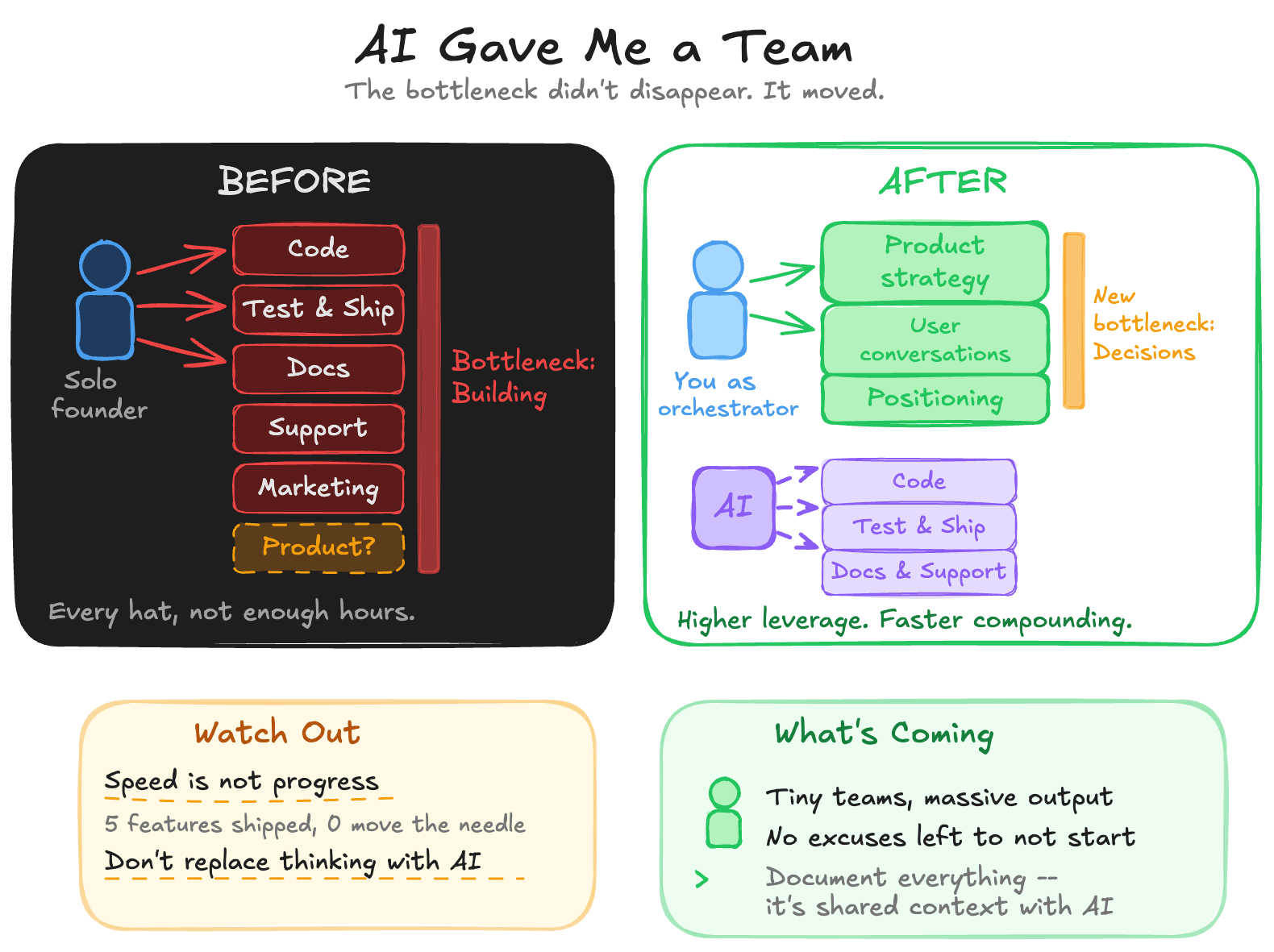
The bottleneck used to be building. Now it's deciding what to build. Here's how AI shifted what's possible when you're bootstrapping alone.
How AI Made Scope Creep My Biggest Threat and Why Speed Is Not a Strategy
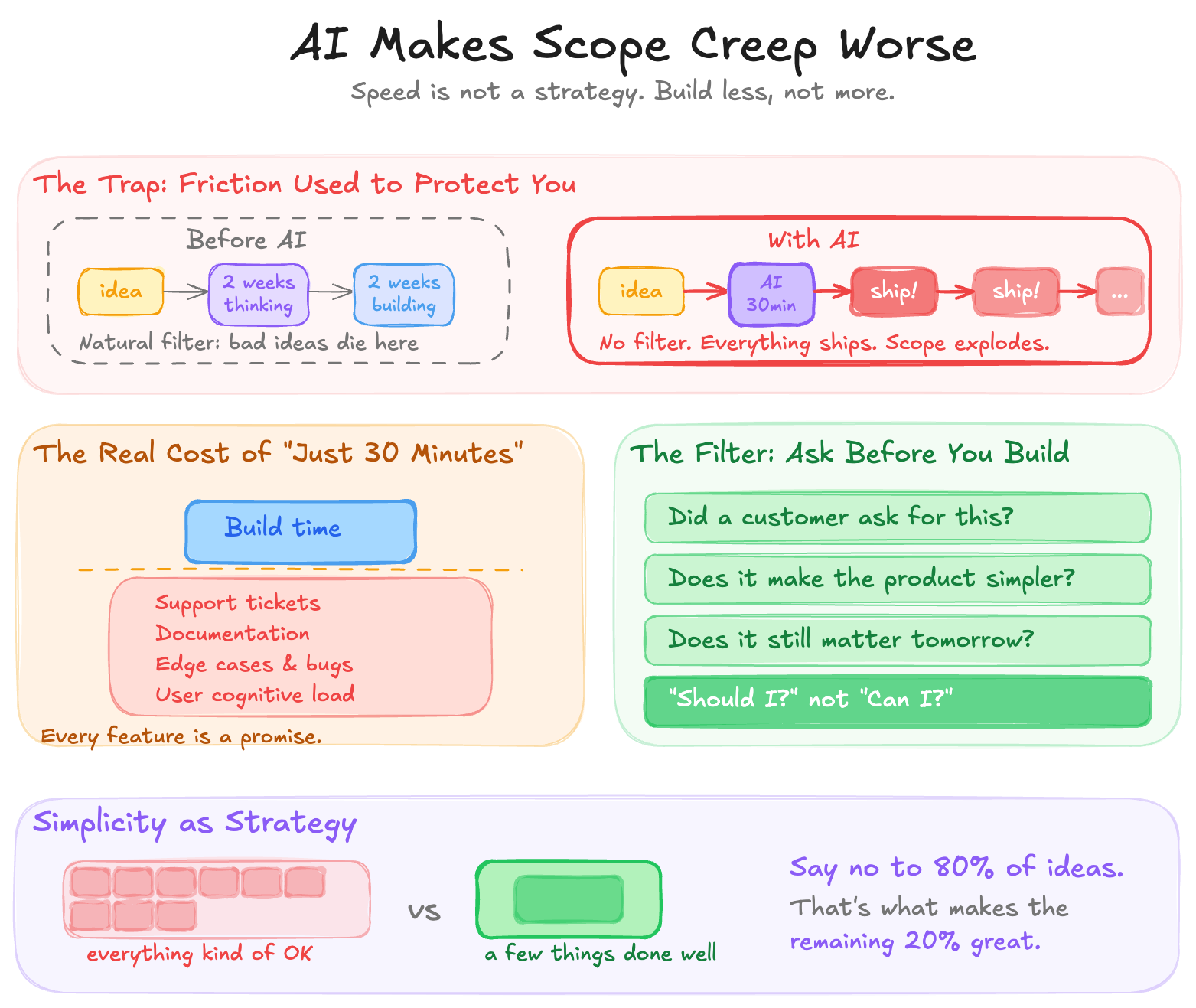
AI makes building faster than ever. That's exactly why it's more important than ever to build less.
New visual every week
Short visual breakdowns on pricing, growth, and the realities of bootstrapping. Delivered to your inbox. No fluff.