How AI Made Scope Creep My Biggest Threat and Why Speed Is Not a Strategy
AI makes building faster than ever. That's exactly why it's more important than ever to build less.
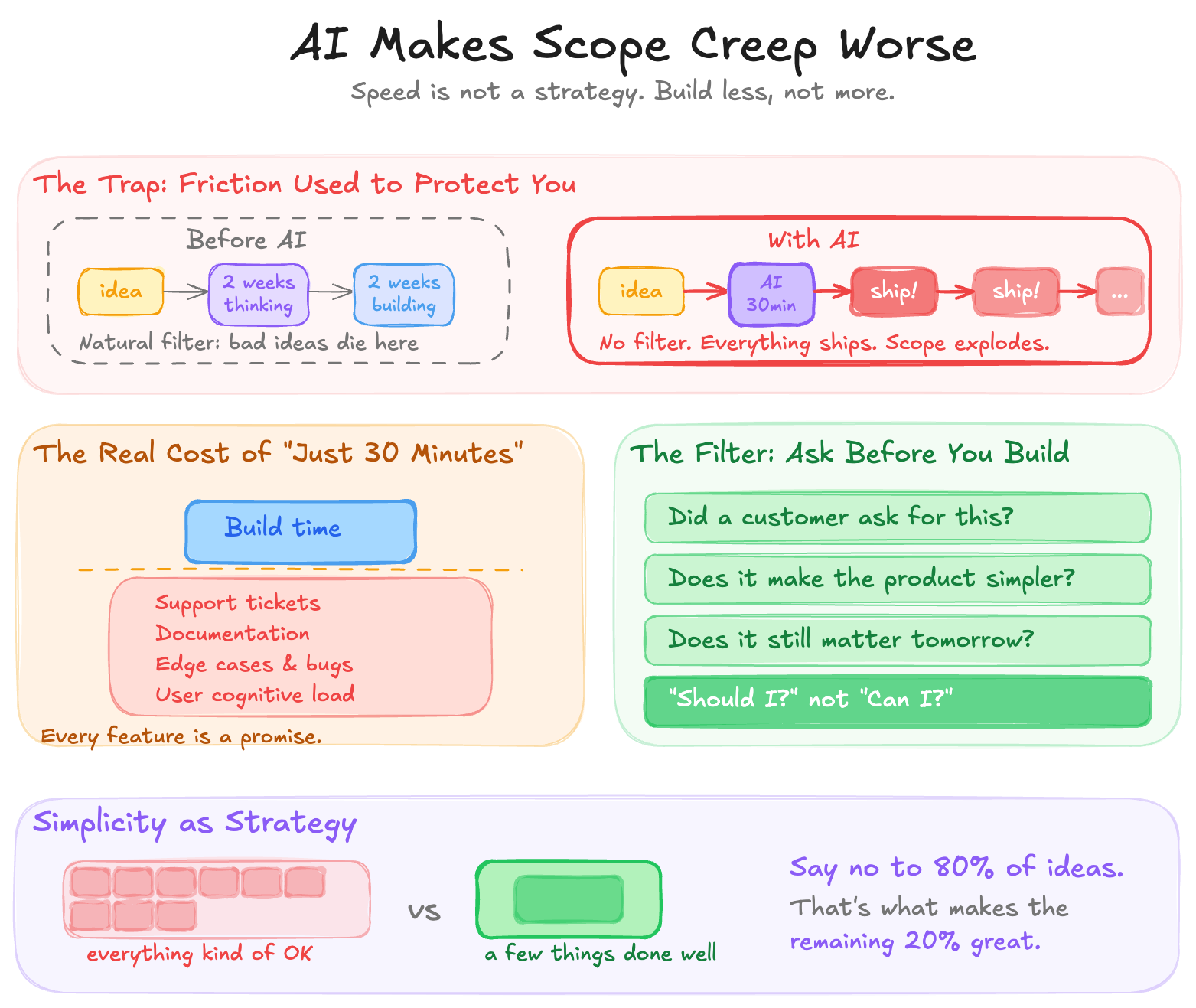
Here’s something I didn’t expect. The better AI tools get, the harder it is to stay disciplined about what I build. Fourteen months ago, I had a natural filter. If a feature was going to take two weeks to build, I had to really want it. I had to justify the time. Now? I can describe an idea to Claude Code faster than I can sketch a mockup. And that changes everything about how scope creep sneaks in.
I’ve fallen into this trap more times than I’d like to admit. “Just add this one thing.” “It’ll only take an hour.” The problem isn’t that the feature is bad. The problem is that every feature you ship is a feature your users have to learn, and a feature you have to maintain. I’ve watched users struggle to keep up with changes because I was shipping faster than they could absorb.
The truth is, your users are craving simplicity. They want a product that feels good, that’s easy to get started with, that doesn’t overwhelm them. And the only way to give them that is to build less, not more. Here’s what I’ve learned about keeping scope creep in check when AI makes everything feel possible.
The Trap
- It’s faster to describe an idea than to evaluate it. That’s the core problem. The friction that used to protect you from bad ideas is gone. You used to have time to think while you built. Now the building happens before the thinking.
- “It only took 30 minutes” is the most dangerous sentence in your vocabulary. The cost of a feature is never the time it took to build. It’s the support tickets, the documentation, the edge cases, the cognitive load on your users.
- AI doesn’t have product sense. It’ll build whatever you ask for, brilliantly. But it can’t tell you whether you should be asking in the first place. That’s still your job, and it’s more important than ever.
- Experimentation feels productive but can be a distraction. Building cool things is fun. I get it. But fun and valuable aren’t the same thing. Something to consider next time you’re about to ship something “just because you can.”
The Real Cost
- Users can’t absorb features as fast as you can ship them. I’ve seen this firsthand. You push three updates in a week and people start feeling lost. The product they liked yesterday feels different today.
- Every feature is a promise. Once it’s out there, someone depends on it. Now you’re maintaining it, fixing bugs in it, making sure it works with the next thing you build. That compounds fast.
- Think about what your product feels like to someone using it for the first time. If they’re overwhelmed, it doesn’t matter how powerful it is. They’ll leave before they get to the good stuff.
- Feature bloat is the slow death of simple products. The products people love most are the ones that do a few things really well. Not the ones that do everything kind of OK.
The Filter
- Before you build, ask: did a customer ask for this? If the answer is no, that’s a red flag. You might be building for yourself, not for them.
- Keep UX and DX at the front of your mind. How does the product feel? Is it easy to get up and running? Are there barriers to entry? What’s the onboarding like? These questions won’t go away no matter how good AI gets.
- Sleep on it. Seriously. If the idea still feels important tomorrow, maybe it’s worth building. If you’ve already forgotten about it, you just saved yourself a maintenance headache.
- Think about whether this makes the product simpler or more complex. The best features remove friction. The worst ones add options. There’s a difference.
- “Can I build this?” is the wrong question. “Should I build this?” is the right one. AI shifted the bottleneck from capability to judgment. Your judgment is now the most valuable thing you bring to your product.
Simplicity as Strategy
- Simple products win. Not because they’re easy to build, but because they’re easy to use. That’s what people pay for. That’s what they recommend to others.
- Your role is changing. AI can be the builder now. Your job is to be the product person. To decide what not to build. To protect the experience. That’s harder than writing code, and it matters more.
- Constraints are a feature, not a bug. Saying no to 80% of ideas is what makes the remaining 20% great. Don’t let AI’s speed erode your ability to say no.
- Think about the products you love most. Chances are they feel focused. They do one thing or a few things really well. That’s not an accident. Someone said no to a thousand other ideas to get there.
- Simplicity is a competitive advantage that compounds. While others are drowning in features, a focused product becomes easier to use, easier to support, and easier to grow. That’s a position worth protecting.
Related Visuals
I Got to $23K MRR Without Stripe and What That Taught Me About Starting Simple
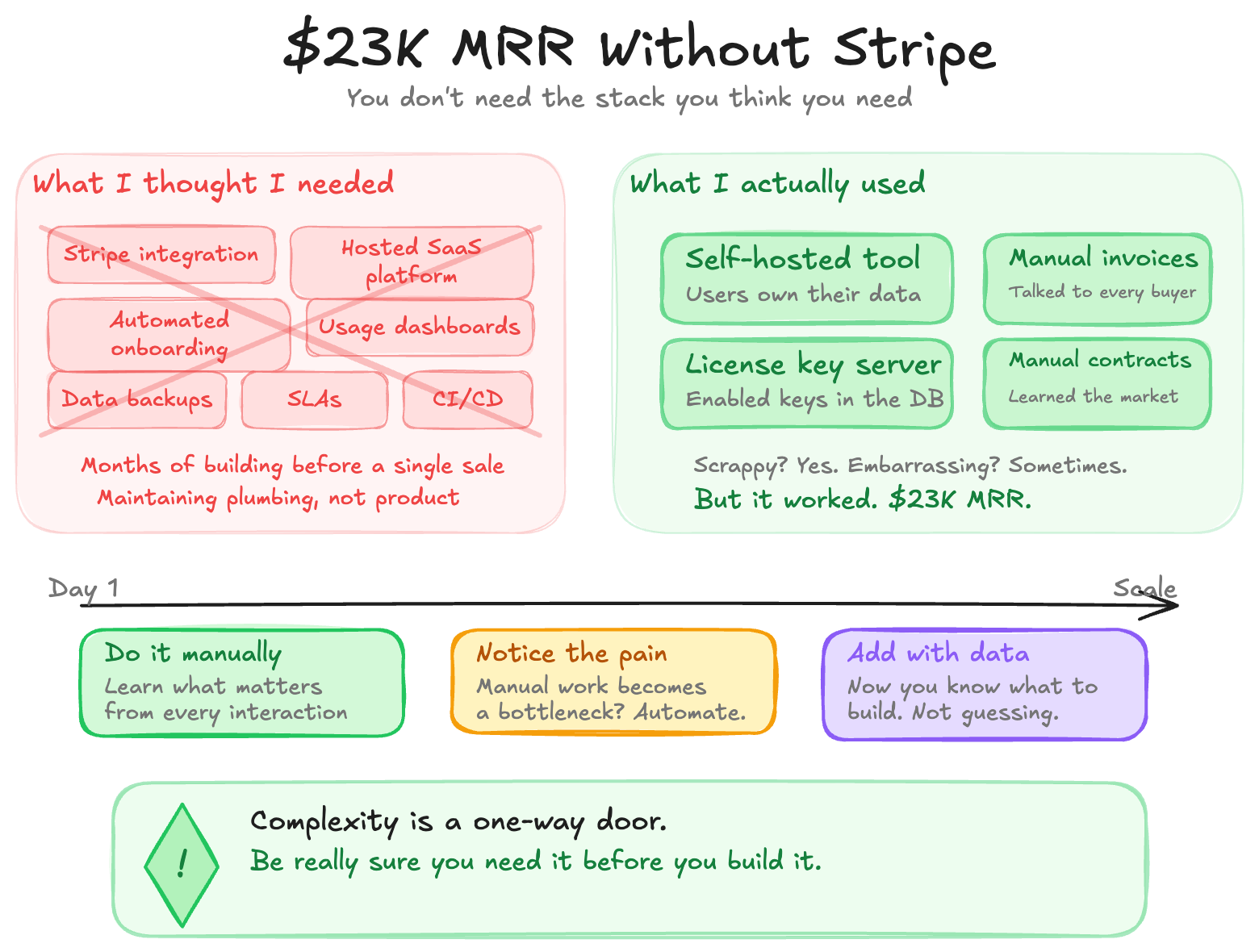
You don't need half the infrastructure you think you need. Here's what actually matters when you're building something from zero.
How AI Gave Me the Capacity of a Small Team and Why That Changes Everything for Solo Founders
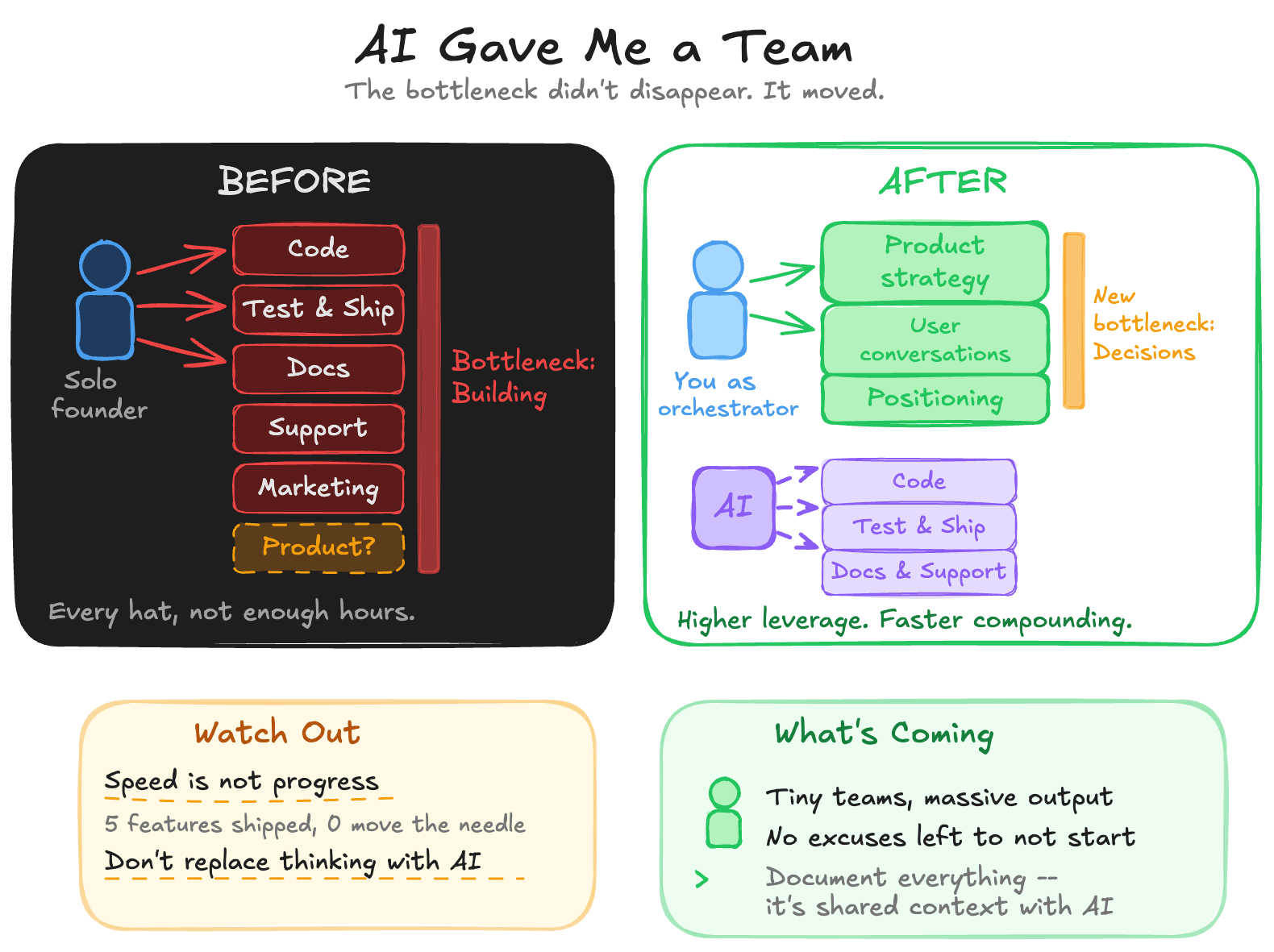
The bottleneck used to be building. Now it's deciding what to build. Here's how AI shifted what's possible when you're bootstrapping alone.
New visual every week
Short visual breakdowns on pricing, growth, and the realities of bootstrapping. Delivered to your inbox. No fluff.