How AI Gave Me the Capacity of a Small Team and Why That Changes Everything for Solo Founders
The bottleneck used to be building. Now it's deciding what to build. Here's how AI shifted what's possible when you're bootstrapping alone.
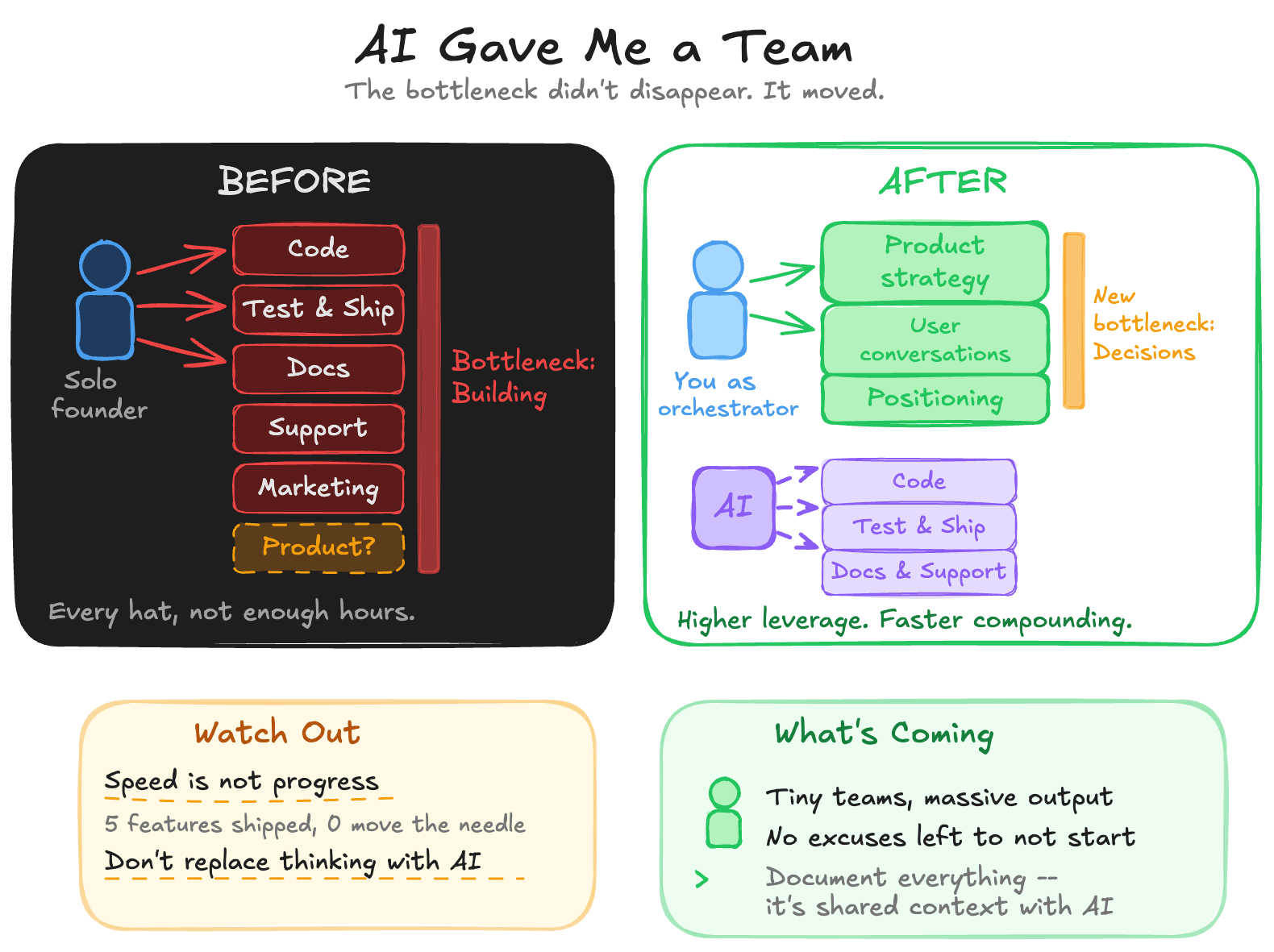
I’ve been building EventCatalog on and off for four years. For most of that time, I was the bottleneck. PR reviews piled up. Code took days to ship. Invoices, contracts, GitHub issues, releases… it all sat on my plate, and there was only so much I could get through in a day. That’s just the reality of being a solo founder. You wear every hat, and some of them don’t fit.
But over the past 14 months of going full-time, something shifted. AI tooling got genuinely good. Not “helpful autocomplete” good. More like “this thing just reviewed my pull request, brainstormed a feature with me, and helped me ship it in a few hours” good. The bottleneck I’d been living with for years started to dissolve. Not completely, but enough that it changed how I think about what’s possible alone.
The thing is, the bottleneck didn’t disappear. It moved. And that’s worth understanding if you’re building something solo. Here’s what I’ve learned about working with AI as a bootstrapper, what it unlocks, and the traps that come with it.
The Bottleneck Moved
- For years, the constraint was building. I had more ideas than I could ship. Features sat in my head for weeks because there weren’t enough hours to code, test, document, and release them. That’s not the constraint anymore.
- Think about where your time actually goes. If you’re still spending most of it writing code, AI can probably take a big chunk of that off your plate. The question shifts from “can I build this?” to “should I build this?”
- The new bottleneck is product thinking. What to build, what to prioritize, how to position it, how to communicate it. These are the decisions that matter most now, and they’re harder to outsource to an AI.
- Something to consider: if AI removes the building constraint, what’s left is the stuff that requires your judgement, your taste, your understanding of your users. That’s where your value is as a founder. Lean into it.
- This is actually good news. Product decisions are higher-leverage than code. Every hour you spend thinking about what to build (instead of how to build it) compounds faster.
What I Actually Do Now
- Most of my coding time is spent orchestrating agents, not writing code myself. I describe what I want, review what comes back, steer the direction. What used to take me days now takes hours. It’s a completely different workflow.
- I use AI across the whole business, not just code. SEO audits, copywriting, product strategy, brainstorming. I’ve built custom skills and agents that understand my project’s vision and mission. They reference my docs. They stay aligned with where I’m headed.
- Think about documenting your vision and keeping it in your codebase. When your AI tools can reference your mission, your brand voice, your product direction, the output quality goes way up. Context is everything.
- The time I save on building goes straight into product and business work. Roadmaps, user conversations, positioning, pricing. The stuff I used to squeeze into the gaps between coding sessions now gets real attention.
- Something to consider: the skill of being a solo founder is shifting. It’s less about being a great coder and more about being a great orchestrator. Learn to direct AI well and you’ll move faster than most small teams.
The Traps That Come With More Capacity
- More capacity means you can ship too much, too fast. I learned this the hard way. If your users can’t keep up with your changes, you’re creating noise, not value. AI makes it easy to build. That doesn’t mean you should release everything you build.
- Watch out for losing your ability to think critically. AI feels like a cheat code sometimes. But if you skip the hard thinking, you skip the learning. You’ll make worse product decisions because you never developed the muscle.
- Think about how much trust you’re putting in AI output. We naturally give it too much credit. It sounds confident even when it’s wrong. Review everything. Question the suggestions. The moment you stop thinking for yourself is the moment your product starts drifting.
- Don’t confuse speed with progress. You can ship five features in a week with AI help. But if none of them move the needle, you just created five things to maintain. Velocity without direction is just busy work.
- Something to consider: the founders who will do best with AI are the ones who use it to free up thinking time, not replace thinking entirely. Stay in the loop. Stay curious. Stay critical.
Smaller Teams, Bigger Output
- We’re going to see a wave of tiny companies doing things that used to require 20-person teams. One or two people with the right AI tooling can build, ship, and support products at a scale that wasn’t possible two years ago. This is just getting started.
- Think about what this means for you personally. If you’ve been waiting to start something because you thought you needed a team, that barrier is lower than it’s ever been. The excuses are running out.
- Self-hosted, bootstrapped products are perfectly positioned for this. No infrastructure to manage. No SLAs. No ops team. Just a product people install and run themselves. AI handles the building, you handle the product and the customers.
- Document everything about your project. Your vision, your tone, your architecture, your decisions. The better your documentation, the better AI can help you. Your codebase becomes the shared context between you and your AI collaborators.
- Something to consider: the playing field is levelling out. Big companies have more people, but solo founders have more speed and more focus. AI amplifies both. If you can move fast and stay focused, you can compete with anyone.
Related Visuals
I Got to $23K MRR Without Stripe and What That Taught Me About Starting Simple
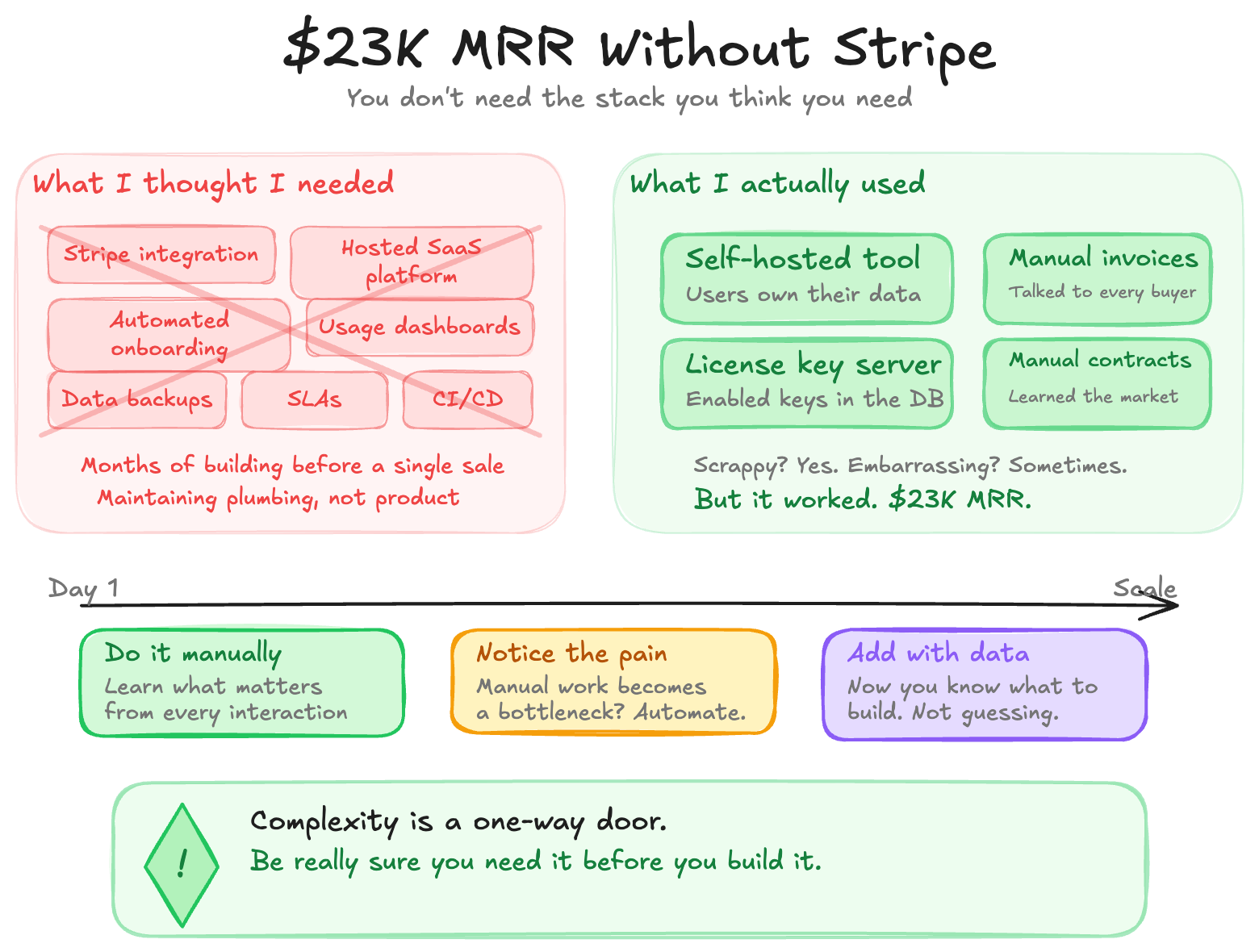
You don't need half the infrastructure you think you need. Here's what actually matters when you're building something from zero.
I Confused Shipping Speed With Product Speed
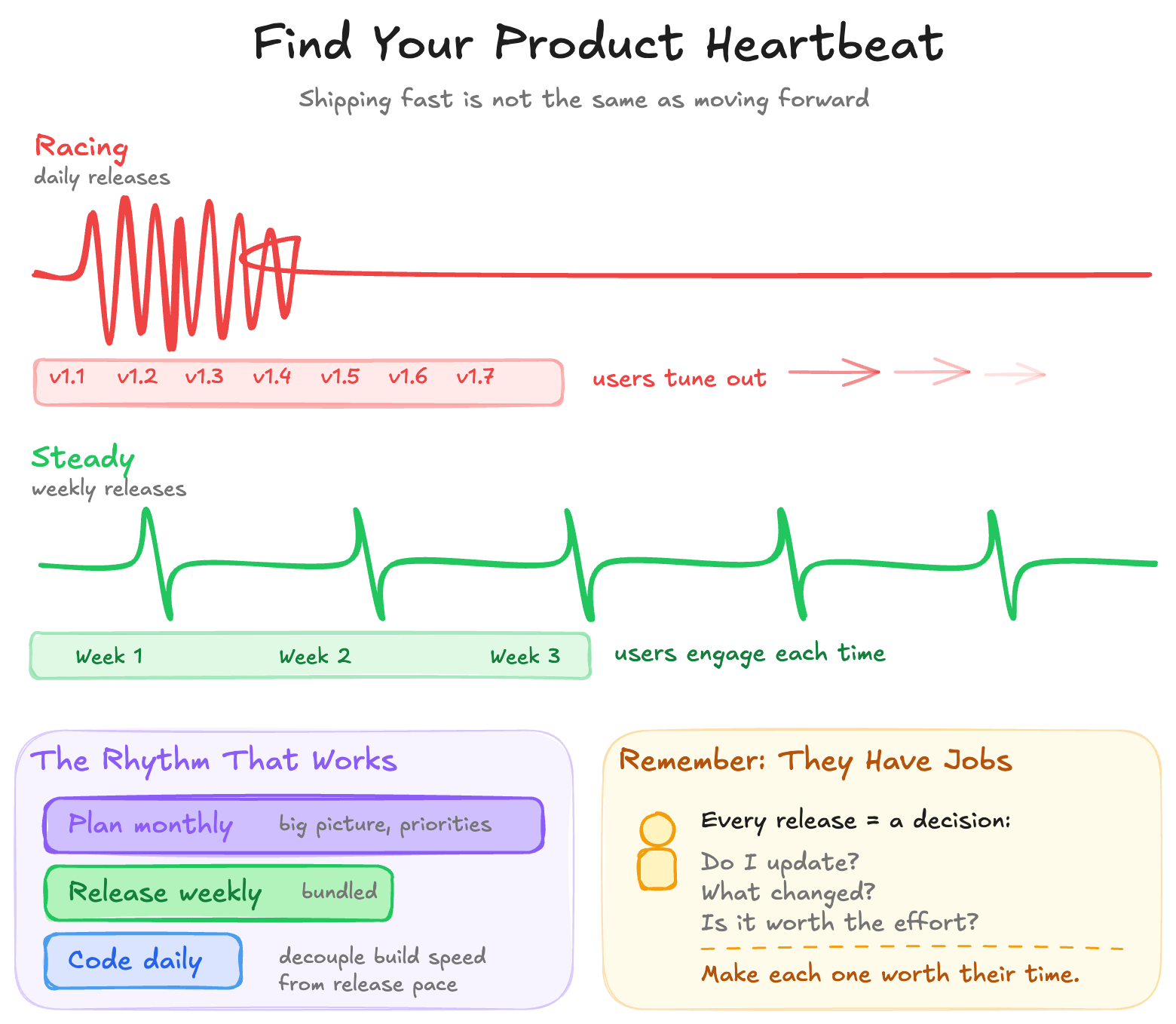
Shipping fast doesn't mean shipping smart. Here's what I learned about finding the right release cadence when your users have jobs and limited bandwidth.
New visual every week
Short visual breakdowns on pricing, growth, and the realities of bootstrapping. Delivered to your inbox. No fluff.